


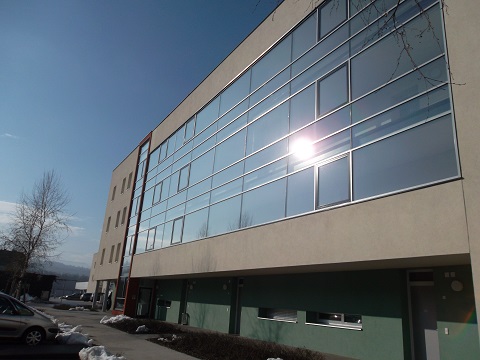
Glint and Glare of a Glass Facade next to the Highway?
Solar Glare Analysis at Vienna Airport helps avoid Glaring Hazard for the Tower
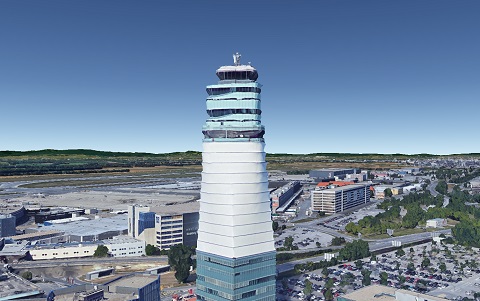
(c) 2017 DigitalGlobe, Landsat / Copernicus
Monitoring and Yield Reporting for PV Parks
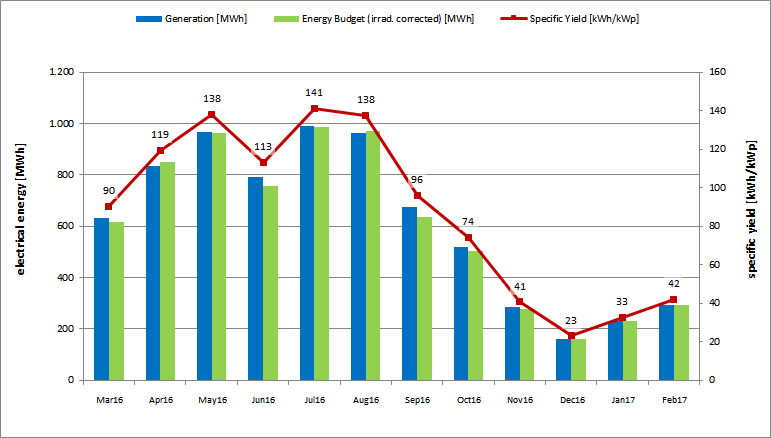 Operations and Maintenance of PV Parks requires continuous yield monitoring. Even short interruptions can cause losses of thousands of Pounds (or Euros), depending on the size of the installation. When a 20 MW PV park is inoperative for a day, 100 MWh of energy can easily be lost, an amount the investor will not have budgeted for. The time for repairs and maintenance for utility-size solar parks has to be chosen in a way that only few sun-hours are lost and the installation stays mostly productive. All operations and maintenance companies therefore streamline their processed to avoid and reduce downtime - especially for large-scale PV parks. Asset Managers - frequently experts from the world of finance, frequently perform a monitoring role in order to assure financial returns for investors. However, since not every Asset Manager has an overview over the technical particularities of photovoltaics, unambiguous performance indicators are needed to assess the effectivity and added-value of the operations and maintenance team.
Solar Glare Assessment for the German Autobahn
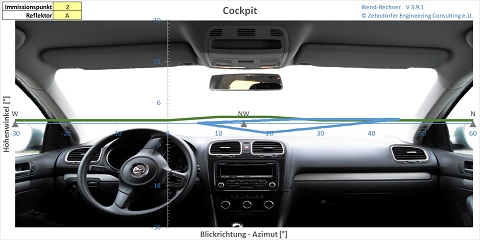 The road authorities of Bavaria / Germany requested a Glint and Glare Study for a planned photovoltaic power plant next to the A3 Autobahn. The assessment had to evaluate the potential Solar Panel Glare from the PV-plant toward vehicles driving on the highway in both directions. Given that the highway's guard rails hide part of the installation, one could believe reflections to be shielded off anyways, but for the higher seated truck and bus drivers the PV installations still would be fully visible and thus a potential source of Solar Panel Reflection.
Solar Glare Assessment for Salzburg Airport
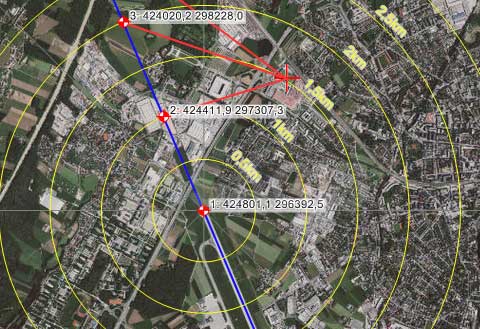 Two PV plants, planned on the roof of a retailer near Salzburg Airport needed a Solar Glare Assessment. The purpose of the glint and glare study was to verify the dazzling effect in the critical take-off and landing phase. The solar plants with a planned size of 200kWp each, have a non-negligible glass surface area which point in the direction of the airport. While for immission safeguarding of neighbors the glare duration is a decisive factor, in this case the emphasis lies on the general potential of dazzling as well as on the angles between glaring and line of vision of pilots (i.e. the heading of the airplane).